The availability of large and rich textual datasets, created mainly from web content have been an important factor in data mining with algorithms or autolearning methods at unprecedented prices. That has generated a high interest in research of automatic learning for text analysis Aggarwal ( 2018 ). Today, text mining Srivastava and Sahami ( 2009 ) and the processing of natural language (PLN] Eisenstein 2019 ) form the basis for many of these studies and implementations.
5.1 Introduction
DATASET-TH-001 Vrandeňci ́ c and Krötzsch ( 2014 ) is an example of a structured and free-access data source that relies on information extracted from DATASET-TH-001 in multiple languages. The information obtained from the Articles of DATASET-TH-001 have been undergoing a semantic notation process to extend the knowledge base of DATASET-TH-001 following a graphic structured data model to integrate new applications.
One of these areas is gender identification in text. The aim is to assign a gender label (e.g., "feminine and male) into an area of text using linguistic properties or other descriptive characteristics. In general, earlier research has focused on identifying the gender and profile of a person who writes his text. Some examples include the gender identification of Yan and Y blogs authors ( 2006 ) and microblogging
Mukherjee and Bala ( 2017 ) or to users of client relations management systems (CRM] Amado et al. 2018 ).
The creation of new inputs from DATASET-TH-001 and structured data in the articles of DATASET-TH-001 to complete every topic. For instance, if we are to get back structured data about "Gabriel García Márquez and have been DATASET-TH-001 the corresponding entry 2. Then we can explore several fields with descriptive characteristics about this person, including "sex or gender. 3. In this example, the value of that property is "male. At the time of writing this article, how precise information can be 6 reference to different articles of DATASET-TH-001 that support the devolution of "male.a
this field using structured data. Nevertheless, as an open project for the collaborative creation of knowledge DATASET-TH-001 have often suffered vandalism and attacks with Adler et al. ( 2011 ); Geiger and Ribes ( 2010 ). If malicious agents have altered the original structured data from DATASET-TH-001, to detect errors without a manual inspection would be an complex task and more so given the great size of its database DATASET-TH-001. Also, if there's no structured information about gender in an article of DATASET-TH-001, it would be impossible to assign a value directly To the "gender or sex 'property for its entry into DATASET-TH-001 That information shall be submitted to the Commission at its first meeting. Instead, to label gender information as an automatic analysis of textual data that have been unstructured in the body from DATASET-TH-001 It could improve resilience to these challenges. That example can be easily extrapolate to any other information system that should automatically label the contents of some text block with a gender tag.
We focused on a specific case, the problem of automatically determining his or her gender as described in biographical text. For the rest of this work, we will discuss that problem as a gender identification. The lack of studies that include languages other than English makes it difficult to develop new text mining procedures with a view better To addressing this problem. Instead of focusing exclusively on english, with fewer gender elements we have been looking at using Spanish text to capture morphemes that carry information about genderand are more common in this language. To achieve this, we will avoid regular normalisation steps in the mining of traditional texts such as derivatives and Eisenstein's lematization ( 2019 ), as they rule out gender information in linguistic terms. Following this approach, we have shown that a gender value can be assigned to textual content with more precision.
When processing text using automatic learning technologies, it's usually useful.
2 [LINK-REDACTED] 3 [LINK-REDACTED]
To conduct vector performances with high dimensional and dispersion as they contain numerous components of zero value. In an environment of scattering high-dimensional representations, MOguerza et al. (SVM) 2006 ) are computatively suitable Jocachims ( 2002 ). Nevertheless, the adaptation of traditional optimization problem resolution technologies for SVM Joachims ( 1999 ) applied to gender identification does not guarantee a quick convergence as the iteration approaches an optimal solution of its underlying optimization problem.
5.2 Proposal
In this Section, as part of the SVM framework we use geometric properties from a text gender identification task to modify an underlying optimization algorithm's stop criterion by replacing Karush- Kuhn-Tucker Feng and Li ( 2018 ) by a new proposal, that incorporates information (the error rate] That isn't directly related mathematically with an criterion which classical optimization SVM algorithm tries to fulfill as it can potentially adapt its nature and geometric problem solve. hereinafter referred to this modified SVM as Geometrics (GLVM). To evaluate the performance of this new approach, these proposals are compared with other Wittan and al monitoring methods ( 2017 ) for automated gender identification within biographical texts of literary authors extracted from DATASET-TH-001. It will be evaluated whether to avoid the common passage of lematization in text mining, which removes gender sufixes with words that are important for texting analysis and improves performance on genderidentification. The GSVM approach's effectiveness for accelerating the training phase of an algorithm is also shown and shows that this method does not significantly affect procedure performance.
5.2.1 Geometric stop criterion
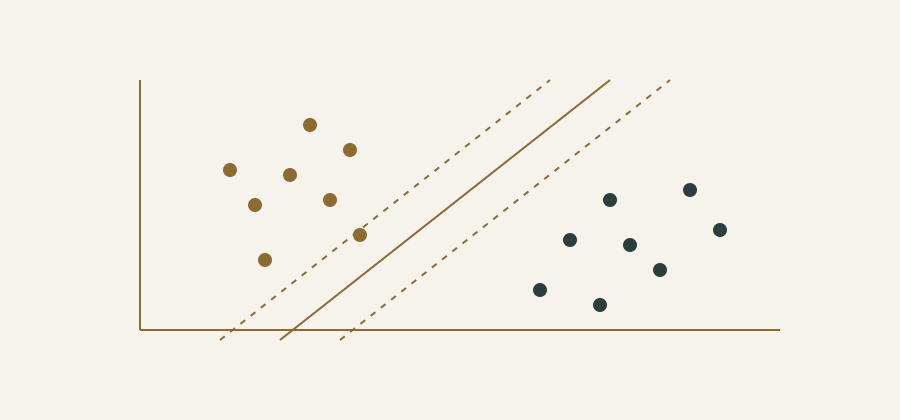
The geometry of SVM decision function linked to training data is quantifiable within each iteration by measuring or estimating the error rate. That is to say, when this error rate stabilizes the decision-making function meets those criteria for effectively classifying data. The figure 5.1 shows an example with two multidimensional Gaussian clouds. The execution of an SVM up to iteration 2 production of the separation surface represented in figure 5.1 a while Figure 5.1 b shows the area of separation calculated up to iteration 18. The figure's decision function 5.1 a provides the same empirical error as figure decision function 5.1 b, that required more iterations and
Thus, more training time for its construction. Instead, the construction of decision-making function in figure 5.1 a He needed less training iterations.
(a) SVM run until iteration 2 (b) SVM run until iteration 18
Figure 5.1 Two separation surfaces with SVM: (a) clearance surface obtained after 2 (b) area of separation calculated after 18 iterations.
Based on these foundations, we define εk as the error rate for training set at iteration K and ∞ > 0 as a true value that acts with tolerance. According to ( 2.3 ),
N X
εk = 1
g
i = 1 ( 1 − yi f (xi) and 5.1 )
Sea δk = ∞ 124; εks − httg ~ 5 |. The method shall be stopped after compliance with the following:
(δk ≤ ∞) 5 {pos ()} 15 {pos (g)} 100 ε), ( 5.2 )
where the symbol ") 'denotes a logical operator and, that is to say with all four inequalities within its criterion should be met simultaneously. By measuring the difference δk ≤ ∞ every five iterations and relaxing a classic criterion, we can avoid unwanted peaks of error caused by randomness. The following theorema shows that there is a direct link between the criteria for detention ( 2.12 ) and 5.2 ).
Theorema 2. Dada ∞ > 0 and ∞ > 0 ), there is a number of iteration ků and β such as δk ≤ ∞ y m (βg.
Proof. To Corollarus 1.1, it is argued that:
L ″ ım k →
m (βk) − M [β ks] = 0
Thus, there is a number of iteration kΩ such that namely k > Kю are met:
m (β k) − M and g.
Be vector β ∗ problem solution ( 2.5 ), where xi such as β ∗ I > 0 are so called support vectors. It's well known that the function f ∗, which determines decision surface g {(x) = 0 Take the form:
N X
f ∗ (x) =
i = 1 β ∗ i yiK (xi, x) + b * 5.3 )
with
b ∗ = − pn i) 1 β ∗ i iK (xi, x +)
2 + pn i = 1 β ∗ i iK (xi, x −)
2,
where x + and x− are two support vectors in classes more 1 and 1 as their associated β + and ″ − Ligrange multiplier have been 0 < β + {C} and 0 < β − > C
Let us consider the decision-making function determined by this problem ( 2.5 ), at iteration k:
N X
f k (x) =
i = 1 β k i yiK (xi, x) + bg.
It's easy to prove that, ″ γ > 0, there's a kloe iteration number such as.k > qy:
g k (x) − f ∗ 5.4 )
That's because of the theorema. 1 That means that:
L ″ ım k → ∞ β g = ß ∗,
and thus that 0 there is a number of iteration kν such that, namely k > q.n. it's met That:
β k − α ″ ≤ ν.
If we take and how small, ( 5.4 ) is met for kγ = k. Dada ∞ > 0, if we have and are small enough to ( 5.4 ), and k > kγ with the definition ( 5.1 ), it is satisfied that:
{pos (192,240)} 5 | ≤τ,
and the theorema is valid for kΩ, β = m ″ ax {g-q.a.).
□
Since the criterion ( 5.2 ) relies on the error rate, it's intuitive to set a value for ∞. We can put it, for instance with a) = 0,0005 as an error rate up to 0,05 % can be considered as significantly low. That intuition doesn't exist for the criterion ( 2.12 ) because the magnitude of g (β] cannot be estimated in advance. Section 5.3 we have shown that for the particular case of gender identification in texts, an appropriate generalizing decision area can be found and met ( 5.2 ) in significantly less iterations than required to meet the widely used theoretical criterion ( 2.12 ). The key point is the high-dimensional environment in which text was represented, enabling good empirical generalisation to be achieved quickly. Thus, from an empirical point of view GSVM is expected to inherit the generalization properties for LVM..
5.3 Experiments
In this section, we describe in detail the problem of gender identification and how experiments are set up.
5.3.1 The problem
The problem of gender identification in textual data as a monitoring training classification task challenges. Due to a text block that can be tagged with an individual's gender label, the algorithm should automatically infer this tag. In this case, we consider two potential output labels: L = {"feminine and male) as our experimental dataset only contains instances of these Two Gender Classes. 5.3.3. Thus, we restrict our choice of algorithms to those oriented at binary classification. The same approach could be extended to consider additional output labels, reformulating the problem as a task of grading one against all or multiple tags.
Our framework of work differs from earlier approaches with two challenges.
3).
Although earlier jobs have been followed by conventional text mining procedures, such as derivation we deliberately avoid this step to preserve gender sufix in terms and explore its impact on Gender Identification for texts with a strong tipping of words like Spanish.
Instead of tagging an entity sequence with a name in text, we address the problem about assign A Gender Label to one textblock or complete document describing another person. That's an important problem for many applications, including automatic entry notation into semantic databases.
There are many languages that have been flexing, meaning words can change their form to reflect grammar information as number and time or gender Hedlund et al. ( 2001 ). In Spanish, words that end at.or in a consonant denote male genres while those with an "are mainly feminine. The lemization tries to remove differences between the flexing forms of a word and reduce every words into its root form. That pre-processing has been the standard approach to text mining and information recovery for better accuracy in identifying key terms with a given message.
Nevertheless, as mentioned earlier in Spanish the hyperspsis of many words can be a useful and direct indicator for gender. That's why it seems reasonable to assume that if we do not apply lematization and preserve gender sufixes instead, they can improve the accuracy of their genderidentification. The following strategy for the identification of gender texts is propose:
1. Implement standard text mining procedures to prepare an unprocessed input, including tokenization and empty word disposal (additional implementation details are provided in Section 5.3 ).
2. Prior to the creation of vector representation for each document, conventional text mining methods suggest that some Sproat et al. ( 2001 ), such as lematisation to remove flexing challenges and provide a typical representation of similar words while reducing vocabulary size. Instead, we propose to suppress this step of text normalisation and instead preserve flexative sufixes that contain additional information about gender in specific languages.
3. Then we re-select the standard document production process, generating a vector representation of each paper and building an term - letter matrix (again more details are given in Section). 5.3 ).
That strategy applies to the production of textual data that will train an autolearning algorithm for gender identification. To prove the applicability of this procedure in an actual environment, we have designed a number to conduct validation experiments and these are described as follows.
5.3.2 Configure of experiments
The main goal is to evaluate the capacity of our proposed framework for automatic gender identification associated with real-world text documents. To this end, we have regained biographical articles describing literary authors from the Spanish and English versions of DATASET-TH-001 and its data feed other systems based on semantic knowledge as DATASET-TH-001. Thus, two different datasets have been created and one for each language. We have designed our dataset to ensure an equal representation of both labels at biographical inputs chosen for his and her Spanish experiments.
When applying our procedure as an entry text in both Spanish and English, we aim to confirm if avoiding referral has a positive impact on the performance of your gender identifier. Our select dataset was biographies of male and female authors. That choice allows us to frame the experiment as a binary classification problem for which there are several standard autolearning algorithms. The figure 5.2 shows a general description of the experimental procedure for evaluating each supervised learning method.
Each dataset of biographies in English and Spanish is divided into training or testing subsets. Specifically, 70 % of biographies in each language are used for training while 30 % remains as a test set to evaluate the performance of monitored learning algorithms. The following Section provides additional details about the recovery and production of both datasets.
5.3.3 Data sets used
We have begun, recovering biographies from literary authors of DATASET-TH-001 by monitoring their web directly using the package DATASET-TH-001 Keyes and Til-
Figure 5.2: A description of the proposed framework for testing alternative monitoring methods.
SOFTWARE-TH-003 ( 2017 ) available for statistical environment R, ORG-TH-112 ( 2022 ). The package can get a list of pages, subcategories and page contents as well with other information about an individual category.
The public dataset available in Gomez and al. ( 2021 (a), 4 contains 1000 biographies of writers extracted from DATASET-TH-001 in the English language. These articles are equally divided into a group of women and an array with men. The biographies of women have been extracted from the category "writers _ women.and their first 500 pages from the category "writers _ men] of The 19th Century have been obtained for man's biographies.
The public dataset available in Spanish Gomez and al. ( 2021 (b)
5 contains 832 biographies from DATASET-TH-001 in Spanish. The biographies of women have been extracted from the category "Spanish Writers. To the contrary, first 416 pages from the category "Spanish Writers of The 20th Century 'have been retrieved for men's biographies. Thus, these biographies are also divided into two sub-sets: one of women and another about men.
The table 5.1 summarizes some general statistics from a preliminary exploratory analysis of the datasets in English and Spanish as described above.
We previously process each biography using an R package of text mining tm Feinereer et al. ( 2008 ). To remove from biographies empty words (common terms that normally do not provide useful information for analysis) Eisens-
4 [LINK-REDACTED] 5 [LINK-REDACTED]
Table 5.1: The total and average number describing datasets in both Spanish or English.
Dataset Description statistics Value
Total number of biographies and genomics 500 Ag. number of distinct terms per female write biography 50,86
Ag. number of distinct terms per female write biography (staging) 38,11
English
Total number of biographies about male authors 500 Ag. number of distinct terms per biography 46,2
Ag. number of distinct terms per male write biography (staging) 35,62
Total number of biographies and genomics 416 Ag. number of distinct terms per female write biography 50,03
Ag. number of distinct terms per female write biography (staging) 31,44
Spanish
Total number of biographies about male authors 416 Ag. number of distinct terms per male write biography 51,39
Ag. number of distinct terms per male write biography (staging) 32,68
Tein ( 2019 ), number and sign of score with blank spaces. The text of each biography will later be converted to minor and the relative term-biography matrix as shown in this table. 5.2. Thus, each biographical set can be represented as a m × n matrix and with an N number of biographies in the training package. Each wij element of the term-biography matrix represents an important or weight name for i in g biography. To get wi j's value we use the TF-IDA Aizawa ( 2003 ), calculated as ( 5.5 ):
!, ( 5.5 )
wi = t fi j × log N
d fi
where t fi j denotes the number of occurrences from term i in biography J; g is a total figure for biographies and finally, d F3 indicates how many biographis have been found at that time.
It should be noted that only training biographies contribute to the construction of terms dictionary representing all biographis. That is to say, when the classifier checks new biographies about a test subset that
Table 5.2: Example of a term-biography matrix, where wi j represents the importance and terms i at biographical entrance J.
Dictionary Biography 1 Biography 2... Biography
University W11 w12... aw1n Marriage and M21, F9) Writer wm1 Wm2...
quier term found not in biographies of the training set is ignored for calculation from distance. Also, our study did not consider synonyms and abbreviations or alternative forms for a given term.
5.3.4 Results
The results of experiments that compare different strategies for gender identification in texts are presented here. The experiments for each classification algorithm involve ten trials of training test divisions selected at the azar.To be able to back up results, we have performed tests from Wilcoxon Hollander et al. ( 2013 ), having considered the statistical significance for p values less than 0, 05.
GSVM versus standard AVS
The following sections summarize the results of evaluating experiments that compare GSVM with standard VMS in text gender identification problem.
Comparison of itherations number: GSVM versus standard AVS
The table 5.3 Comparison of Iterations count for GSVM and a typical VMS using the classic stop criterion. It's clear that with an average of about GSVM for the Spanish dataset 18 % (with derivatives) and 25 % (without derivatives) less iterations than the standard SVM approach. At the same time, GSVM can reduce its number of iterations by about 42 % (with derivatives) and 44 % (without derivatives). The great values in the standard deviation for GSVM are a result of both approaches reaching as high an iterations number defined to some experiments, understand how many iteration have been established with this model.
Wilcoxon's test of the dataset available in English shows that GSVM improved relative to LVMN was statistically significant, both as applied and with a high
ca the stemming (p = value 0,00195 ) as if not applied (p = 0,00589 ). If we look at the case of Spanish biographies, this improvement is statistically significant if stemming isn't included (p = value 0,00195 ) but isn't significant when using stemming (p value = 0,1 ).
Table 5.3: Average (prom.) and standard deviation of iteration count at training stages
Language Method Stemming No staging
avg. s.d. p-value vg.a. p-values
Spanish 357,500 10,445 0,1 395,100 10,105 0,00195 GSVM 294,100 89,709 293,000 49,844
English SVM 612,000 16,855 0,00195 614,600 7,394 0,00589 GSVM 359,000 10,220 349,500 69,100
The figures 5.3 a, 5.3 b, 5.4 a and 5.4 b have been shown graphically for each experiment at what count of GSVM and standard AVS iterations stop their training performance, respectively. The GSVM stop criterion detects how soon the error rate indicator will be stabilized (tipline). Instead, the classical SVM detention criterion requires an increased number of iterations to stop without providing any improved error rate.
It should be emphasized that the performance of GSVM's stop criterion for biographies in English is similar, regardless as to whether or not lematisation preprocessing was applied (see Figures). 5.3 b and 5.4 b). Another remarkable finding is that the error rate for biographies in Spanish (see Figures) 5.3 a and 5.4 a) Expand an oscillating pattern when applying the derivation preprocessing (Figure 5.4 (a). That conduct may be due to a significant loss of information introduced by the referral operation in this language.
Finally, it should be mentioned that the assessment metrics are very similar in all cases for "feminine 'and (male) production labels with both languages.
Comparison of GSVM vs. accuracy Standard SVM
To evaluate the performance of standard SVM technique with GOVM. we have been monitoring precision, recall and score metrics F1 Baeza-Yates & Ribeiro ( 2011 ); Sokolova and Lapalme ( 2009 ); Olson and Delen ( 2008 ). The table 5.4 shows a comparison of SVM and GLVM. for biographies in English with or without derivation. For each method and metric, this table shows the mean (avg.) with standard deviation [s.d.] Also, the p-value of Wilcoxon's test for each comparison is shown. The Wilcoxon test results indicate that there are no statistically significant differences for any of the metrics considered, as and how it is indicated in a p-value column where all values have been higher than 0,05.
(a) Spanish
(b) English language
Figure 5.3: No derivation. Comparison of detention criteria if you do not use referral preprocessing.
The results shown in Tables 5.4 and 5.5 they have been shown empirically that for text gender identification problems, GSVM's techniques inherit the same properties as those of LVMs and provide similar precision results.
The table 5.5 shows a comparison of SVM and GSSM. for Spanish biographies with or without derivation. Again, for each method and metric this table shows the mean (avg.) with standard deviation [s.d.] as well at corresponding p values of Wilcoxon's test Similarly to the biographies in English, Wilcoxon's test results indicate that there are no statistically significant differences for either metric (p-values have been higher than 0.05 ). That's how they...
(a) Spanish
(b) English language
Figure 5.4 Comparison of the criteria for his or her detention with reference to a referral preprocessing.
Table 5.4: English. SVM and GLVM. performance technologies for biographies in English, with or without derivation.
Stem. Gender Method Precision Recall F1 score
(s.d.) p-value avg.
No Female SVM 0,919 ( 0,038 ) 0,812 0,873 ( 0,011 ) 0,188 0,895 ( 0,021 ) 0,438 GSVM 0,908 ( 0,039 ) 0,859 ( 0,093 ) 0,879 ( 0,049 )
Male SVM 0,865 ( 0,018 ) 0,63 0,917 ( 0,031 ) 1 0,889 ( 0,014 ) 1 GSVM 0,823 ( 0,205 ) 0,909 ( 0,036 ) 0,843 ( 0,159 )
Yes Female SVM 0,911 ( 0,044 ) 0,812 0,879 ( 0,018 ) 0,0625 0,894 ( 0,027 ) 0,312 GSVM 0,880 ( 0,049 ) 0,898 ( 0,036 ) 0,888 ( 0,031 )
Male SVM 0,873 ( 0,018 ) 0,125 0,910 ( 0,036 ) 1 0,891 ( 0,017 ) 0,438 GSVM 0,899 ( 0,036 ) 0,884 ( 0,035 ) 0,891 ( 0,020 )
The number of iteration achieved by GSVM does not have an impact on the accuracy and
the classification.
Table 5.5 Spanish. SVM and GLVM. performance technologies for biographies in Spanish, with or without derivation.
Stem. Gender Method Precision Recall F1 score
(s.d.) p-value avg.
No Female SVM 0,929 ( 0,028 ) 1 0,918 ( 0,019 ) 0,0625 0,923 ( 0,014 ) 0,625 GSVM 0,909 ( 0,065 ) 0,907 ( 0,093 ) 0,903 ( 0,042 )
Male SVM 0,913 ( 0,034 ) 0,188 0,929 ( 0,020 ) 1 0,920 ( 0,018 ) 0,188 GSVM 0,889 ( 0,140 ) 0,913 ( 0,057 ) 0,891 ( 0,079 )
Yes Female SVM 0,751 ( 0,092 ) 0,0625 0,810 ( 0,072 ) 0,0625 0,773 ( 0,040 ) 0,625 GSVM 0,770 ( 0,177 ) 0,781 ( 0,139 ) 0,747 ( 0,079 )
Male SVM 0,809 ( 0,115 ) 0,0625 0,768 ( 0,054 ) 0,125 0,780 ( 0,054 ) 0,0625 GSVM 0,724 ( 0,251 ) 0,790 ( 0,105 ) 0,713 ( 0,155 )
The table 5.6 sample for GSVM a comparison between derivation and non-derivative, with the corresponding p values. For Spanish biographies, the results show a significant degradation when including derivation with p-values of 0, 0097, 0, 00586 and 0, 00195 for precision, recall and F1 score respectively in the female genres. 0, 0137, 0, 00195 and 0, 00195 for precision, recall and F1 score respectively in male genres. Instead, for biographies in English the p values of all metrics exceed their level and 0,05 That indicates an absence of a significant effect.
Table 5.6: Comparison of derivation performance metrics versus non-derivative when applying GSVM.
Language Gender Stem Precision Recall F1 score
avg. p-value aw.p-valuation wings.ct
Spanish Female No 0,909 0,0097 0,907 0,00586 0,903 0,00195 Yes 0,770 0,781 0,747
Male No 0,889 0,0137 0,913 0,00195 0,891 0,00195 Yes 0,724 0,790 0,713
English Female No 0,908 0,343 0,859 0,124 0,879 1 Yes 0,880 0,898 0,888
Male No 0,823 0,108 0,909 0,286 0,843 0,636 Yes 0,899 0,884 0,891
GSVM vs. other algorithms
That subsection compares GSVM's performance and training time with other autolearning methods, such as Random Forests (RF) Breiman. 2001 ) and Boosting Schapire ( 1990 ), from common software bookstores. In these tests, algorithm hyperparameters are set at their default values. For each algorithm and language, we compare two alternative text mining workflows for every metric: (i) they include a deviation step as with most conventional texting applications. We use time as a metric
Comparison as there is no fair comparison of iteration counts, with each method's implementation following a different iteration approach.
Comparison of training time: GSVM versus other algorithms
The table 5.7 sum up the run time (in seconds) for all versions of algorithms used with this research. Using derivation for Spanish, GSVM is on average up 10,05 times faster than the Boosting and 42,87 sometimes faster than RF, while for the English language GSVM is an average up 15,79 times faster than Boosting and 59,15 times faster than RF. When derivation does not apply, GSVM is as an average up 49,63 times faster than Boosting and 81,00 times faster than RF. GSVM's as an average 22,91 times faster than Boosting and 77,70 times faster than RF. To sum up, with the Wilcoxon test performed and a statistically significant difference between methods indicates that GSVM training time is consistently shorter than in other technologies.
Table 5.7: mean (avg.) and standard deviation [s.d.] of training time
Language Method Stemming No staging
avg. (s.d.) p-value apr.tit
Spanish GSVM 3,096 ( 0,460 ) 2,889 ( 0,150 ) Boosting 31,110 ( 1,001 ) 0,002 143,370 ( 289,894 ) 0,002 RF 132,718 ( 46,366 ) 0,002 234,024 ( 71,339 ) 0,002
Spanish GSVM 3,799 ( 0,074 ) 3,883 ( 0,525 ) Boosting 59,978 ( 6,650 ) 0,002 88,976 ( 18,596 ) 0,002 RF 224,732 ( 17,882 ) 0,002 301,715 ( 6,568 ) 0,002
Precision Comparison: GSVM versus other algorithms
Since the derivation doesn't appear to be significant with processing biographies in English, for space reasons we will focus our analysis on his and her Spanish. The table 5.8 shows a derivation comparison versus non-derivative and the corresponding p values for GSVM, Boosting or Random Forest. GSVM gets very promising results, especially when derivation isn't used with precision and recall. F1 score above 90 % In most cases, though Boosting and Random Forest mainly improve GSVM performance. The fact that both technologies belong to those known as whole methods (Sagi and Rokach, 2018 ). By training multiple models and integrating their predictions, these methods improve the predictive performance of a single model. It should be noted that, as GSVM behaves with a standard MVS in terms of precision these results prove the importance and relevance to derivation from non-referral into languages such at Spanish level. That preprocessing technique as well
affects the results to be obtained using other types of classimators.
Also, the p values of this table 5.8 show a significant degradation in performance of all algorithms when applying the derivation. The results consistently show that for Spanish, with no derivation and accuracy of the F1 score have been higher than 90 % in most cases, while using derivation a rounding of degradation occurs. 15 %.
Table 5.8: Precision technologies for biographies methods in Spanish.
Method Gender Stem Precision Recall F1 score
(s.d.) p-value avg.
GSVM Female No 0,909 ( 0,065 ) 0,00977 0,907 ( 0,093 ) 0,00586 0,903 ( 0,042 ) 0,00195 Yes 0,770 ( 0,177 ) 0,781 ( 0,139 ) 0,747 ( 0,079 )
Male No 0,889 ( 0,140 ) 0,0137 0,913 ( 0,057 ) 0,00195 0,891 ( 0,079 ) 0,00195 Yes 0,724 ( 0,251 ) 0,790 ( 0,105 ) 0,713 ( 0,155 )
Boosting Female No 0,944 ( 0,018 ) 0,00195 0,938 ( 0,017 ) 0,00195 0,941 ( 0,012 ) 0,00195 Yes 0,769 ( 0,044 ) 0,694 ( 0,037 ) 0,729 ( 0,022 )
Male No 0,936 ( 0,020 ) 0,00195 0,943 ( 0,015 ) 0,00195 0,939 ( 0,011 ) 0,00195 Yes 0,655 ( 0,038 ) 0,736 ( 0,053 ) 0,691 ( 0,027 )
RF Female No 0,957 ( 0,016 ) 0,00195 0,970 ( 0,022 ) 0,00195 0,963 ( 0,011 ) 0,00195 Yes 0,816 ( 0,046 ) 0,790 ( 0,065 ) 0,800 ( 0,037 )
Male No 0,971 ( 0,021 ) 0,00195 0,956 ( 0,020 ) 0,00195 0,963 ( 0,012 ) 0,00195 Yes 0,779 ( 0,066 ) 0,806 ( 0,048 ) 0,789 ( 0,036 )
5.4 Conclusions
In this Section, we consider some explanations for the differences found in gender identification performance and these reflect on potential limitations of our work.
5.4.1 Comparison of classification algorithms
The results suggest that monitoring Stemming's application in textual data production, performance metrics are quite similar independently of the autolearning algorithm selected for classification. Nevertheless, there are differences depending on the language used.
As a result, we can conclude that autolearning classification algorithms for gender identification may be directly affected by sufixes present in datasets used to train the algorithm. Our results confirm that Stemming's preprocessing, a method which apparently simplifies the classification problem can induce gender confusion to solve this issue.
5.4.2 Impact of Stemming Removal
A main goal of the proposed framework is to explain whether retention and monitoring with information about gender in some languages, such as Spanish can provide a better classification performance for genderidentification. According to the results presented in these tables 5.6 and 5.8, there's a quite remarkable increase in Spanish rating performance for the algorithms that we have been considering with our experiments when derivation passing is removed from data production.
Instead, results for the English language indicate a minimum variation in F1 score metric between Stemming and non-Scentering applying or preparing data to any classification algorithm. That language has similar results with respect to recall's accuracy and performance metrics.
Overall, these results support our initial consideration that avoiding Stemming's implementation can positively affect gender identification in texts When content is available with languages providing additional morphological details bringing about genderinformation such as Spanish. Confirming knowledge obtained from previous research about the importance of data production phase, especially if work with languages other than Uysal and Gunto ( 2014 ).
5.4.3 Constraints
The new GSVM method that introduces an early stop criterion for the training phase works well with a specific problem of text gender identification. Additional experiments should therefore be performed to evaluate GSVM performance in other classification tasks before recommending MSSG as an overall methodological innovation of VMS with automatic learning.
With regard to the proposed framework for gender text identification, an important limitation of our experimental environment is that we have confined a target gendervariable with binary choice. Problem raised by other Hamidi et al. ( 2018 ); Keyes ( 2018 ). In fact, did you find that 55 of 58 studies for automatic gender identification with autolearning assumed a binary gener output. In this sense, a potential path for future research could be to replace our binary classification algorithms with an alternative as they may have been automatic learning models that admit continuous and / or multitilaric targets. In such contexts, it would be interesting to evaluate whether gender sufixes still have some benefits for the identification of genres.
A further limitation of our approach is that the text may not be available in a strongly inflamed language, different from English. Nevertheless, in that case the text could be translated automatically from Spanish to Russian or other languages with similar properties through Automated Services. The translated version of the text can provide additional gender information that allows to optimize classification performance. Similarly, more research is required to confirm that these initial results comparing Spanish and English are replicable with data entry into alternative languages.
5.4.4 Innovation
In this research, we have a new stop criterion for support vector optimization algorithms based on the geometric properties of text content vectorial representation with an aim to solve automated gender identification problem. For this particular problem, we show that the proposed algorithm requires less time for training if compared with applying standard SVM algorithms. With respect to the framework, instead of following conventional normalization procedures in text mining that eliminate gender challenges such as referral we preserve these morphological elements found with heavily inflicted languages and have them optimized their performance. We evaluate how effectively this new approach can be put into terms of training times by comparing different autolearning algorithms for classification, using a biographical input dataset. DATASET-TH-001 and Spanish.
Our results suggest that avoid a referral (stemming) to the preprocessing of text for languages including additional elements with gender information, such as Spanish and so forth. That procedure shift did not affect other neutral languages as English.