Your decision
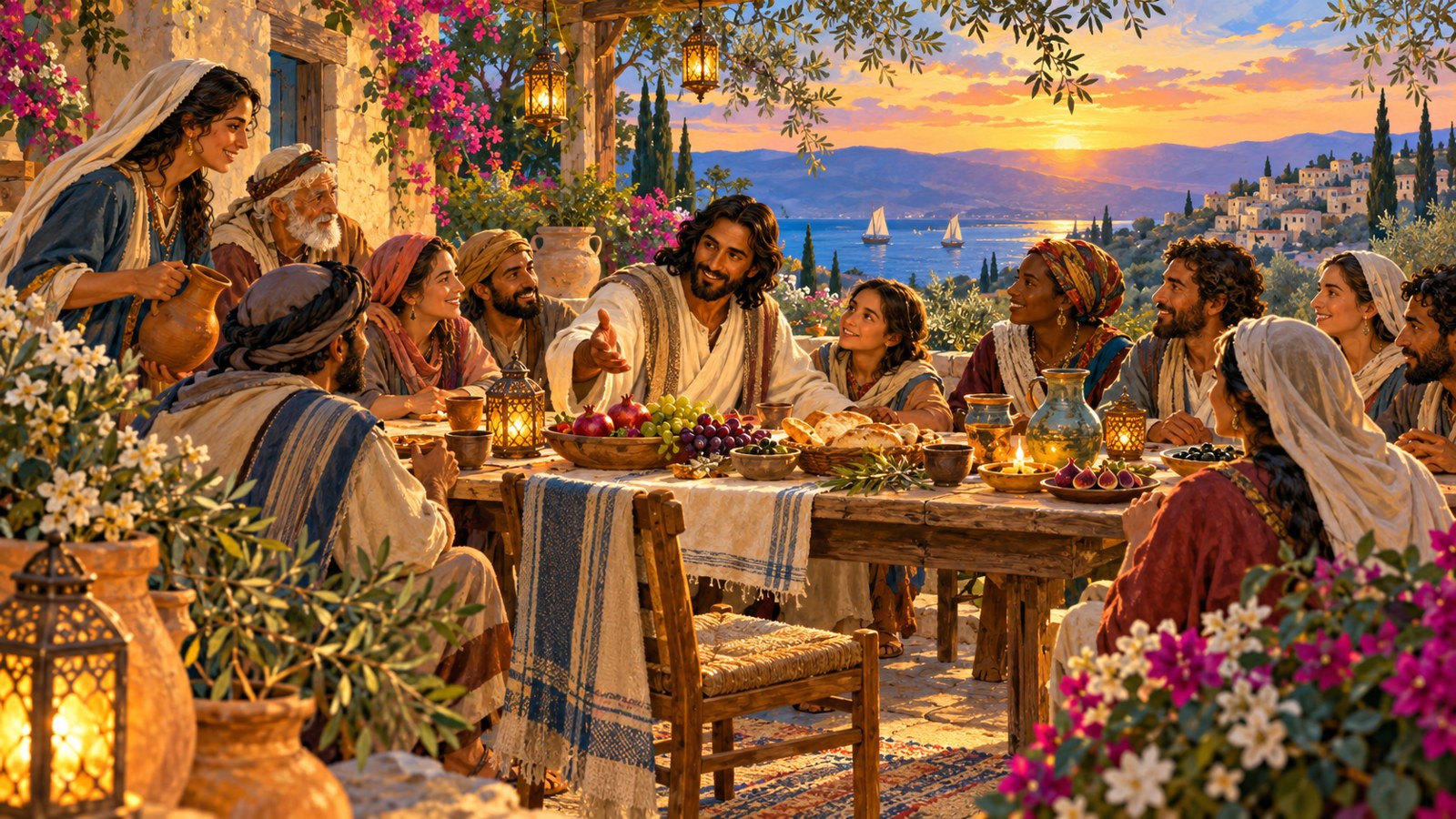
You organize a reading of the Gospel. How do you share your hope while respecting the freedom of others?
Open an option to discover what may follow. You can change your mind.
Inviting without pressing
An invitation opens up a possibility respecting freedom.
Ask How to Host
Hospitality listens before deciding for another.
Require it to fit first
Reception becomes meaningless if it requires erasing the identity of those who arrive.
Open the secret door
Beyond the doorway
Sharing one hope does not require controlling someone else’s conscience.
Reading note
Jesus lived and taught within the Jewish world. These controversies do not describe an entire people or justify prejudice against any religion. “Hacking” here means repairing through love, not digital intrusion.
The translations were generated locally by machine and await full linguistic review. The scenes are editorial adaptations; their dialogue is not a literal quotation from Jesus. The highlighted biblical passages in this translation are editorial paraphrases, not quotations from an official Bible translation.
Read in context: Matthew 28:16–20
The manuscript text
The manuscript text is retained with organization names coded. Its historical interpretations and classifications belong to the essay and are not validated historical measurements.
A message for all nations
Historical Context:In Jesus' time, the prevailing belief among Jews was that they, as descendants of Abraham and guardians of the Law of Moses, had a special relationship with God. Gentiles (non-Jews) were considered foreigners who were not given the promise of salvation. This exclusive perspective was reinforced by strict observance of the laws of purity and isolation of pagan nations. The idea of extending salvation to all peoples and cultures was not only contrary to religious expectations, but also subverted the identity of the Jewish people as the "chosen people." Jesus broke with this vision by making the message of salvation universal.
Editorial paraphrase of the passage: The disciples are sent to all nations to teach and baptize. (Matthew 28:19).
Degree of transgression at the time:Very high. Proclaiming that salvation was available to all nations and not just Jews was a direct challenge to the exclusive theology prevailing in Judaism of its time. In an environment where Jewish identity was defined by separation and ritual purity, Jesus not only opened the doors to the Gentiles, but also sent his disciples to spread his message throughout the world. This statement implied a break with the tradition of centuries of cultural and religious separation, and was seen as heresy by many Jewish leaders.
Meaning in the Age of Jesus: By sending his disciples to all nations, Jesus redefined the relationship between God and humanity. He showed that God’s love and grace were not limited to a single ethnic group, nation or religious group, but extended to all. This act not only universalized the Gospel message, but also changed the way Jesus' followers were to understand his mission: not as a sectarian movement, but as a call to all humanity. With this, Jesus not only expanded the scope of the message of salvation, but also removed any barrier of exclusivity.
Contemporary Analysis:Today, this message of total inclusion remains relevant in a world divided by borders, religions and cultures. Announce that everyone is welcome in God’s Kingdom, regardless of background, nationality, or beliefs, challenges systems that foster nationalism, xenophobia, and religious sectarianism. The mandate to go to "all nations" translates into a call for openness, hospitality and acceptance of diversity. At a time when fear of “the alien” is common, Jesus’ message remains radically transgressive.
Impact on the world today: This event has inspired millions to work for inclusion and acceptance of people from different cultures and traditions. From the first missionaries to modern religious communities advocating interreligious understanding, Jesus ’ statement has pushed his followers to see humanity as one family. Today, this message also manifests itself in movements for social justice and human rights, where the idea of universal dignity is at the centre of many efforts to eliminate racism, ethnocentrism and other forms of exclusion.
Degree of transgression at present:Medium-High. Despite advances in global acceptance and understanding, sectarianism and exclusionism remain problems in many religious and social communities. The idea that everyone has the same right to salvation, dignity and acceptance is still controversial. This message challenges those who seek to maintain faith as a tool of exclusion or separation rather than reconciliation and unity.
Conclusion: By sending his disciples to all nations, Jesus not only expanded his mission; he changed forever the way in which mankind must understand God. Today, his act calls us to break down the borders that separate people for reasons of ethnicity, nationality or religion. Jesus challenges us to see every human being as a brother or sister with equal access to divine grace and love. This message, though simple, remains revolutionary, as it invites a divided world to reconcile itself in universal love that transcends any difference.