Your decision
Someone comes back after a disease and fears that you only see one label. How do you go with respect?
Open an option to discover what may follow. You can change your mind.
Offering a concrete gesture
A small gesture can turn intent into care.
Find shared support
Sustainable aid is also organized in a network.
Leave it for later
Maybe there's a need that can't wait. Try another answer.
Open the secret door
Beyond the doorway
Dignity does not depend on health or productivity.
Reading note
Jesus lived and taught within the Jewish world. These controversies do not describe an entire people or justify prejudice against any religion. “Hacking” here means repairing through love, not digital intrusion.
The translations were generated locally by machine and await full linguistic review. The scenes are editorial adaptations; their dialogue is not a literal quotation from Jesus. The highlighted biblical passages in this translation are editorial paraphrases, not quotations from an official Bible translation.
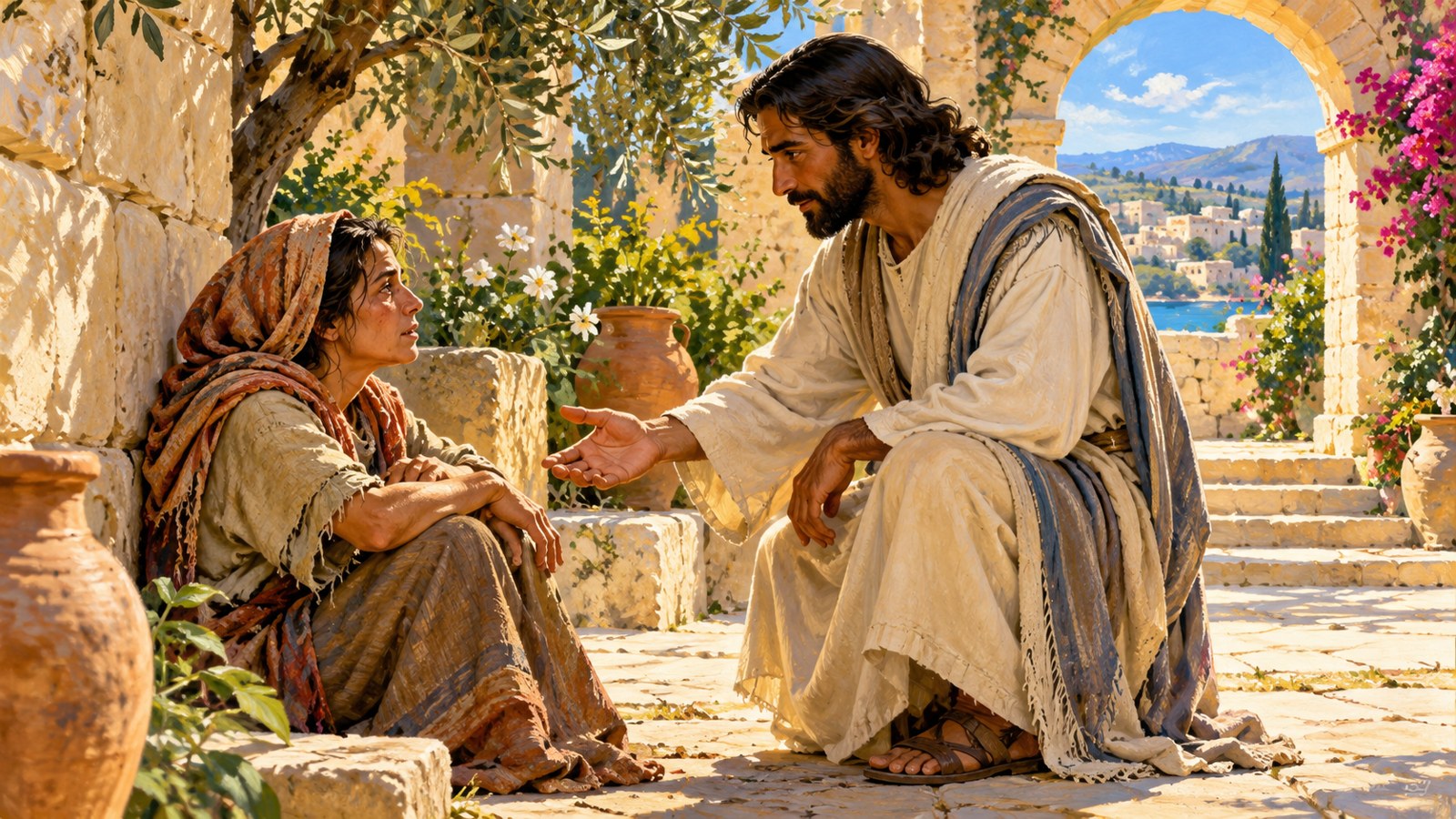
Read in context: Matthew 9:20–22
The manuscript text
The manuscript text is retained with organization names coded. Its historical interpretations and classifications belong to the essay and are not validated historical measurements.
Dignity beyond ritual labels
Historical context:In the Jewish tradition of the first century, the laws of ritual purity were very strict, especially as regards women. A woman with a flow of blood was considered ritually impure, and anyone who had physical contact with her became unclean as well. Women in this condition were excluded from social and religious life, and should stay away from others so as not to “contaminate”. In this context, the woman with blood flow who approached Jesus and touched him broke several rules by trying to seek healing for herself.
Editorial paraphrase of the passage: Jesus encourages the woman and recognizes her faith. (Matthew 9:22).
Degree of transgression at the time:Very high. The mere fact that a woman with prolonged blood flow touched a man in public was enough for the community to condemn her and consider that man “unclean” according to the Law of Moses. This meant not only an act of audacity on the part of women, but also jeopardized Jesus ’ reputation and ritual purity. In a context where women with that condition were invisible and treated as marginalized, Jesus healing her and calling her “daughter” was an unprecedented act of vindication and dignification.
Meaning in Jesus' time: By allowing him to touch it and by publicly healing it, Jesus challenged the notion of ritual purity and stigma surrounding women with physical conditions. He not only healed her, but restored her dignity in front of everyone, showing her that her courage did not depend on her physical state. By calling her “daughter”, Jesus gave her a status and respect that was not expected of someone in her situation. This act challenged the logic of exclusion and separation from ritual law, showing that true purity came from love and compassion, not strict compliance with norms.
Contemporary Analysis:In the modern world, this act can be seen as a symbol of rejection of discrimination based on a person's state of health or physical conditions. As in ancient times, people with certain illnesses or conditions (e.g. people with HIV/AIDS or disabilities) are often stigmatized and marginalized. Jesus shows us that true love transcends the prejudices and labels that society imposes. In addition, this act calls for inclusion and respect, especially for those in situations of vulnerability and exclusion.
Impact on the world today: Jesus' act inspires many to work for the dignity of those who are considered “impure” or marginalized by society. His gesture has motivated movements for the inclusion of people with disabilities, stigmatized diseases or any condition that makes them “untouchable” in the social sense. The healing of women was not only physical; it was a restoration of their place in the community, something that remains relevant today for those who advocate social justice and equality.
Degree of transgression at present:Medium-High. Although progress has been made in accepting people with different conditions, prejudices and stigma still exist. In many cultures, contact with certain groups is seen with fear or rejection. The act of Jesus continues to challenge communities to break with these prejudices and to see human dignity in each person, regardless of their physical state.
Conclusion: By healing the woman and allowing her to touch her, Jesus not only broke with a ritual norm, but showed that true purity is in the heart. This act remains a challenge for our modern societies, which often exclude those who do not conform to certain standards of “normality”. Jesus calls us to break the barriers of stigmatization and value every human being as worthy of respect and unconditional love.