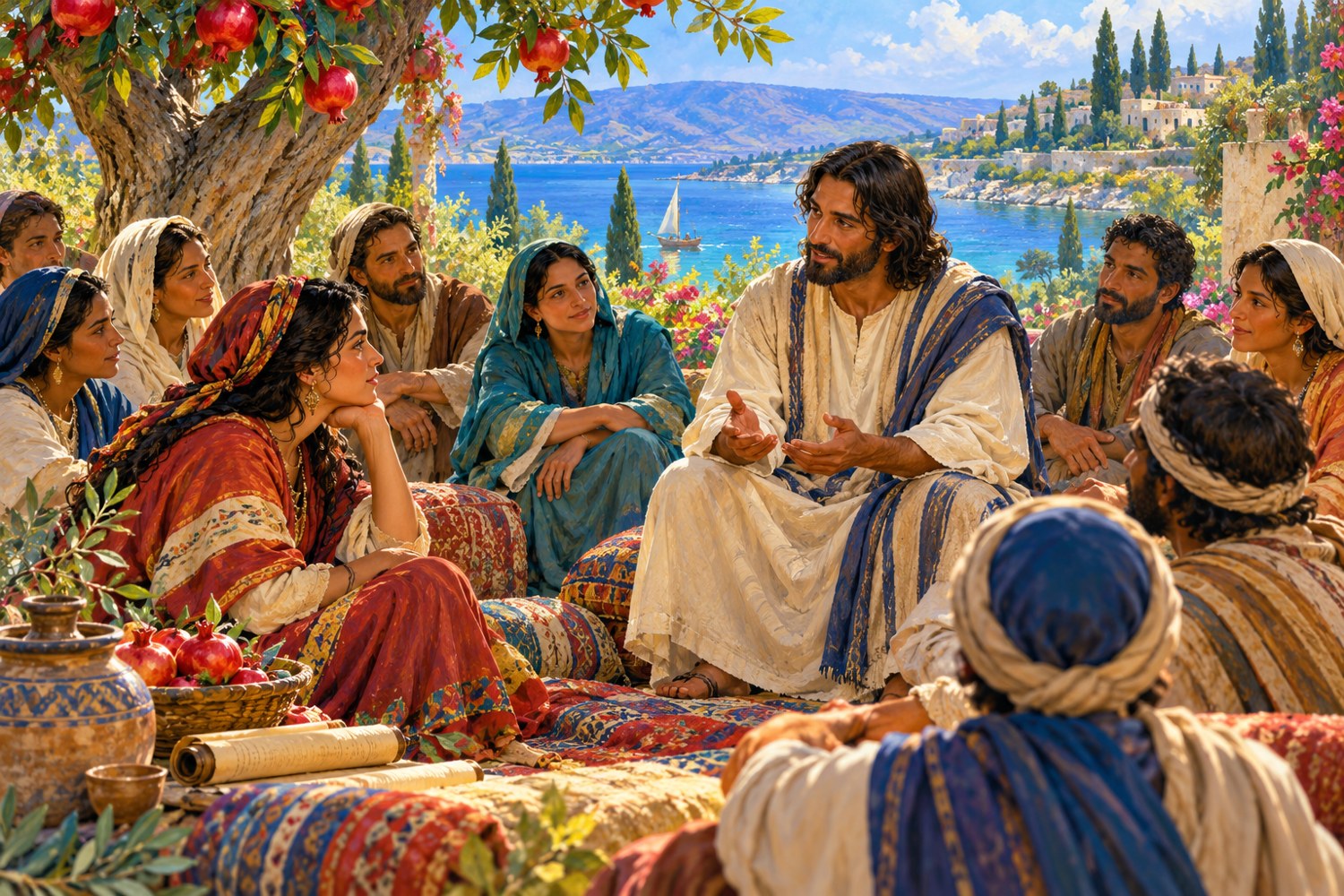
Your decision
A girl wants to participate in a family reunion. How do you give him room to talk?
Open an option to discover what may follow. You can change your mind.
Listen first
Listening opens up space to know a real need.
Ask what you need
A respectful question takes care of the autonomy of the other person.
Deciding without listening
You can reconsider: helping doesn't mean replacing someone else's voice.
Open the secret door
Beyond the doorway
You don't need to be important to deserve a welcome.
Reading note
Jesus lived and taught within the Jewish world. These controversies do not describe an entire people or justify prejudice against any religion. “Hacking” here means repairing through love, not digital intrusion.
The translations were generated locally by machine and await full linguistic review. The scenes are editorial adaptations; their dialogue is not a literal quotation from Jesus. The highlighted biblical passages in this translation are editorial paraphrases, not quotations from an official Bible translation.
Read in context: Mark 10:13–16
The manuscript text
The manuscript text is retained with organization names coded. Its historical interpretations and classifications belong to the essay and are not validated historical measurements.
Welcoming children
Historical context:In the society of the first century, children occupied a marginal place. They were considered the property of their parents, with very few rights and without a voice of their own. The idea that children were "future adults" and not complete beings until maturity was reflected in how they were treated: above all, obedience and submission were expected. They were not considered important, nor were they given access to education or religious life. In this context, Jesus ’ attitude toward children was radically different.
Editorial paraphrase of the passage: Let the children come; do not stand in their way. (Mark 10:14).
Degree of transgression at the time:Stop. By giving children a central role and making them the model of those who would inherit God’s kingdom, Jesus subverted the expectations of his time. Not only did he speak to them, but he openly defended them in front of the adults who wanted to drive them away. This was seen as an infringement of social hierarchies, where children did not have the right to be the center of attention, much less in the context of teaching and spiritual leadership.
Meaning in Jesus' time: When Jesus valued the children and declared them “heirs of the Kingdom,” he broke the rule that social importance depended on age and status. He placed children, the most humble and dependent of society, as a model of what it meant to be part of God’s Kingdom: having a pure heart, being receptive and fully trusting. Jesus raised the condition of children, which represented a call to adults to become like them in spirit, humility and faith.
Contemporary Analysis:Today, this teaching extends to the way we treat children and the most vulnerable in our society. Despite advances in children's rights, millions of children still live in conditions of exploitation, poverty and abuse. This act of Jesus remains a powerful reminder that the value of a human being is not in his productive capacity, but in his inherent dignity. Likewise, his message challenges systems that prioritize power and influence over innocence and purity.
Impact on today's world: Jesus' approach has had a profound impact on how modern societies think about children's rights. The recognition that children should be protected, educated and treated with respect had inspired movements for children ' s rights, the creation of laws to protect them and the eradication of child labour and other forms of abuse. However, Jesus’ call to see children as models remains relevant in a world where success, competition and power are often prioritized.
Current degree of transgression:Medium. Although progress has been made in protecting the rights of children, practices and structures still marginalize and exploit them. Talking about children's rights in certain social and political contexts continues to be transgressive, especially in places where minors are seen as property or workforce. Jesus’ message still challenges societies to put children at the centre of their priorities.
Conclusion: By defending children and setting them as an example, Jesus showed a radically different view of power and courage. He reminded us that true greatness lies in purity, humility and receptivity, not in force or authority. Today, his act calls us to build societies that care for and raise up the smallest and most vulnerable, recognizing their importance and protecting their dignity with the same fervor that Jesus showed.