Your decision
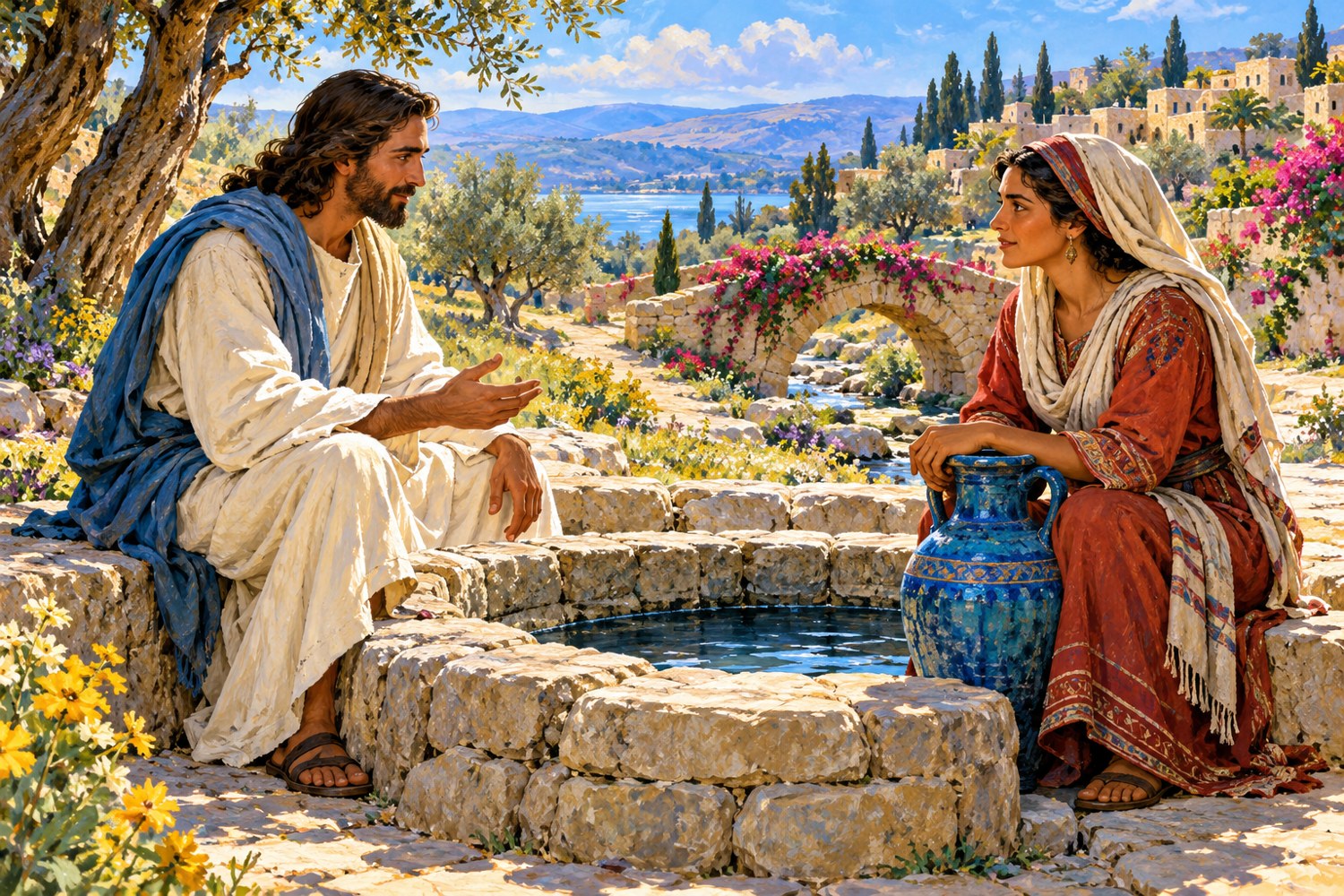
Your neighbor has a different faith. You meet next to a fountain. How do you start the conversation?
Open an option to discover what may follow. You can change your mind.
Verify the facts
The truth allows us to act responsibly.
Speak respectfully
Firmness and respect can walk together.
Spreading an indictment
Humiliation can multiply the damage. You can change your choice.
Open the secret door
Beyond the doorway
The encounter does not require that we think exactly the same.
Reading note
Jesus lived and taught within the Jewish world. These controversies do not describe an entire people or justify prejudice against any religion. “Hacking” here means repairing through love, not digital intrusion.
The translations were generated locally by machine and await full linguistic review. The scenes are editorial adaptations; their dialogue is not a literal quotation from Jesus. The highlighted biblical passages in this translation are editorial paraphrases, not quotations from an official Bible translation.
Read in context: John 4:1–42
The manuscript text
The manuscript text is retained with organization names coded. Its historical interpretations and classifications belong to the essay and are not validated historical measurements.
Speaking with the Samaritan woman
Historical context: The Samaritans were an ethnic and religious group considered heretic by the Jews. Jews and Samaritans did not deal with each other, and a Jewish man would never speak publicly to a woman, especially if she was a Samaritan. Jesus' encounter with the Samaritan woman in the well broke two taboos: ethnic separation and the place of women in society.
Editorial paraphrase of the passage: The account describes a barrier between Jews and Samaritans. (John 4:9).
Degree of transgression at the time:Very high. Speaking to the Samaritan woman, Jesus broke two social norms: first, he talked with a woman in public without the presence of a companion; second, he interacted with a people considered unclean by the Jews. This could have compromised his reputation as a teacher and generated rejection among his own followers.
Meaning in the time of Jesus: By not only speaking, but also offering the woman “living water,” Jesus challenged segregation and showed that salvation was open to all. He transformed Jacob's well, symbol of the division between Jews and Samaritans, into a symbol of reconciliation and unity.
Contemporary Analysis:Today, this act can be compared with crossing the lines of racial, religious and gender prejudices. It represents a call to build bridges where others build walls. Their message is more relevant than ever in a world divided by ethnic hatred and discrimination.
Impact on today's world: The meeting with the Samaritan woman inspires religious and social leaders to promote intercultural and interreligious dialogue. At a time when racial and religious differences are often used to divide, this passage reminds us that true leadership involves breaking down barriers and embracing diversity.
Current degree of transgression:Stop. Although dialogue between cultures and religions was being promoted, it remained a challenge in many communities. Coping with prejudice and stigma is still an act that demands courage and vision.
Conclusion: Jesus not only spoke to the Samaritan woman, but gave her a central role in spreading her message. In doing so, he showed that God’s love knows no boundaries or barriers. Today, this act continues to call us to break down the barriers that still divide humanity.