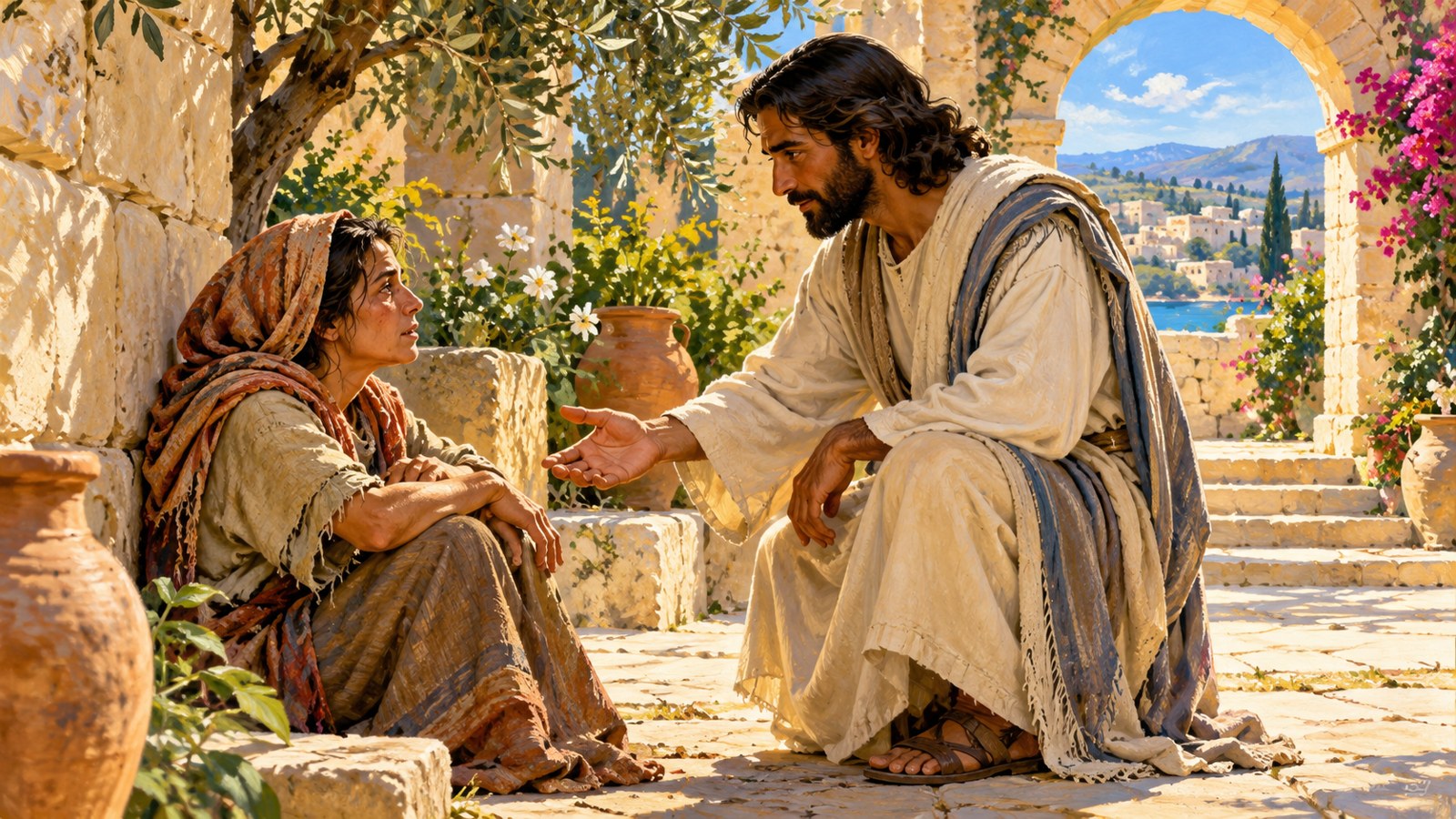
Your decision
An activity ends, but someone needs rest. How do you make room for him without leaving anyone alone?
Open an option to discover what may follow. You can change your mind.
Verify the facts
The truth allows us to act responsibly.
Speak respectfully
Firmness and respect can walk together.
Spreading an indictment
Humiliation can multiply the damage. You can change your choice.
Open the secret door
Beyond the doorway
Standards find their meaning when they protect life and dignity.
Reading note
Jesus lived and taught within the Jewish world. These controversies do not describe an entire people or justify prejudice against any religion. “Hacking” here means repairing through love, not digital intrusion.
The translations were generated locally by machine and await full linguistic review. The scenes are editorial adaptations; their dialogue is not a literal quotation from Jesus. The highlighted biblical passages in this translation are editorial paraphrases, not quotations from an official Bible translation.
Jewish tradition also recognizes the preservation of life above Sabbath rest (Mishna Yoma 8:6 ). The categories and percentages of this essay are opinions of the manuscript; they are not presented as measured historical results.
Read in context: Mark 2:27 y 3:1–6
The manuscript text
The manuscript text is retained with organization names coded. Its historical interpretations and classifications belong to the essay and are not validated historical measurements.
Healing on the Sabbath
Historical Context: In Jesus' time, the Sabbath was the most sacred day of the week for Jews, completely dedicated to rest and worship of God. According to the Law of Moses, no work was permitted. Healing on Saturday was considered an act that violated this Law and therefore a direct challenge to religious authorities.
Editorial paraphrase of the passage: The Sabbath serves human beings, rather than human beings serving the Sabbath. (Mark 2:27).
Degree of transgression at the time:Stop. Healing on the Sabbath went beyond a mere infraction; it involved a reinterpretation of the Scriptures and an attack on the authority of the Pharisees. In doing so, Jesus risked being discredited and accused of blasphemy, as reinterpreting the Law was seen as a challenge to God’s will.
Meaning in the time of Jesus: Jesus challenged the rigid and legalistic approach to Sabbath observance, placing human need above religious norms. With this action, he changed the perception of Saturday as a mandatory day of rest to a day in which the welfare of others should be the priority.
Contemporary Analysis: In the modern world, this act translates as a critique of bureaucracy and norms that, instead of protecting people, end up damaging them. It means that laws and regulations must be flexible when they interfere with fundamental rights or the well-being of people.
Impact on today's world: This passage has resonance today on issues such as labour rights and work policies on holidays. As in Jesus ’ time, the question arises as to when it is appropriate to prioritize human well-being over literal compliance with regulations, and how laws should be adapted to become more human.
Current degree of transgression:Medium. While challenging standards in the name of human rights is more accepted today, it remains transgressive in contexts where labour policies are rigid or when laws are not tailored to individual needs.
Conclusion: Jesus not only healed one person, but redefined the law. His act, rather than healing, was a clear message that love and compassion must prevail over any regulation. Today, this remains a challenge for societies that value standards more than human dignity.